
Into the Abject
A Meditation on Filth, Kristeva and New Juche

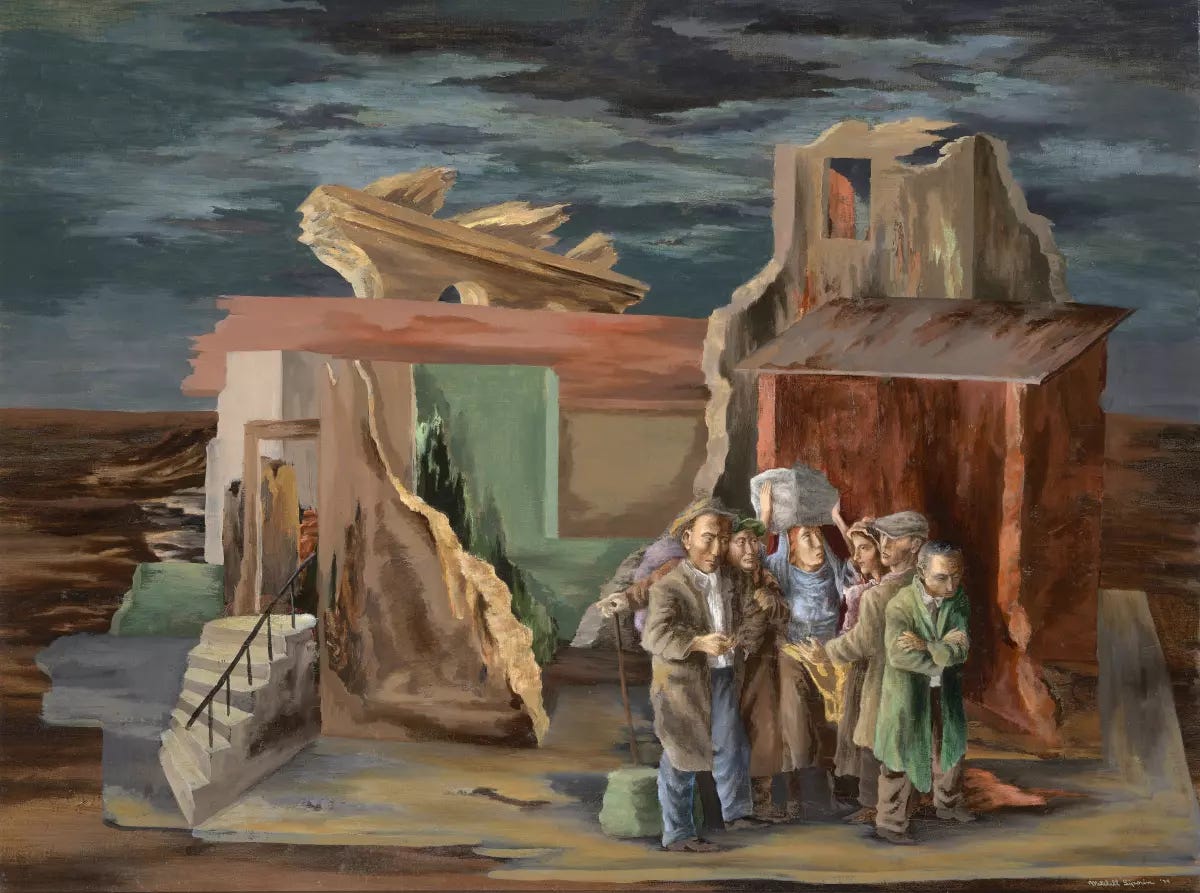
as if the earth under our feet
were
an excrement of some sky

and we degraded prisoners
destined
to hunger until we eat filth
From “To Elsie”, by William Carlos Williams
1. Health Hazards
The week of July 4th, a couple of days before the holiday, a message was sent out through our neighborhood group chat about a family in need of assistance. They were being evicted from their home. Through some sort of misunderstanding or mix-up, the family had found out that they had to be out of the house by nightfall. The details of all of this were murky: something to do with a deceased grandparent, a change in ownership, and a new owner–an investor–demanding that the family leave ASAP.
The sender of the request, a local church leader, asked if anyone might be able to go and help them. It was 2 PM on a Wednesday. Most of the neighborhood at that time, and at such short notice, were, unsurprisingly, busy, but I just so happened to have the day off. Out of a desire to assist, and morbid curiosity to meet this evicted family, to maybe find out how they had wound up in such a difficult situation, I responded that I was available. The church leader was delighted but warned me that there might be some “health hazards” and that, if I found them too objectionable, he’d totally understand. This only heightened my curiosity. What could “health hazards” mean, I wondered, as I threw on some old clothes and headed over.
The house, only half a block away but in a cul-de-sac I rarely entered, was a run-down split-level, yard overgrown, the driveway fully occupied by two immense dumpsters. A haphazard mess of items–furniture, monitors and computers, boxes of odds and ends–were strewn across the lawn. On the street a small uHaul was parked, clearly not big enough for whatever the house contained, not even big enough for the contents of a small storage unit. Apprehensively, I approached the door where I was met by another neighbor, a woman who lived a few doors down. Aside from her and a cousin of the family, I was the only other pair of hands that had shown up.
Beneath all this filth, however, was what remained of the life previously built by the owner. Old books on shelves, behind family pictures, were covered with dust. Knick knacks, souvenirs, and various bric-a-brac went unseen behind rotting piles of garbage. Filing cabinets full, I’m sure, of family documents and history, were unreachable behind mounds of miscellaneous trash. All of it begrimed and repulsive beneath the heavy odor of animal waste, decay, and negligence.
I stepped into the house and was nearly overcome by disgust at how abjectly filthy it was. It took a supreme effort not to reel, repulsed, away from the door and back out into fresh air. The smell alone, a complex, multi-layered stench consisting of new and old dog shit, urine, and weighty musk of extreme neglect, was powerful enough that I could hardly open my mouth without gagging. The living room, to the left of the entryway, had been converted, not intentionally, into a kennel, where dogs were allowed to piss and shit freely. Strangely, or maybe not considering the state of the house, it appeared the dogs also roamed freely through every other room, leaving their waste behind them. Looking down the entryway, I could see, with difficulty, into a portion of the kitchen, where old dishes and fast food detritus were stacked haphazardly on counters and in the sink. From the ceiling, an old ribbon of fly strip hung motionless, peppered with little desiccated corpses.
Beneath all this filth, however, was what remained of the life previously built by the owner. Old books on shelves, behind family pictures, were covered with dust. Knick knacks, souvenirs, and various bric-a-brac went unseen behind rotting piles of garbage. Filing cabinets full, I’m sure, of family documents and history, were unreachable behind mounds of miscellaneous trash. All of it begrimed and repulsive beneath the heavy odor of animal waste, decay, and negligence.
The other neighbor and I were asked to bring a few things out of the basement. The same scenes were present there, with animal waste and trash piled high. Sadly, under all the trash and hoardings, I could see the original “layer” of life, the photos and furniture and family records that had belonged to the original owner, who had died and left the house to her family. It was some of these descendants that had allowed the house to fall into such a state, before the rest of the family, seemingly realizing that there was no way they’d be able to resurrect the family home to its former glory, sold it to an investor.
From a room deep in the basement, where I couldn’t see the floor for the layers of pizza boxes, old clothes, and liquor bottles that covered it, we brought up a bed, an amp, and a bass guitar. I tried to imagine sleeping in a room like this, with the smell always in my nose and the scritch-scratch of rodents tunneling through labyrinthine piles of trash. I couldn’t wrap my mind around it.
I don’t need to spend more time on describing how the rest of the afternoon went. Some more help arrived, we brought a few more odds and ends out, and then helped the family load up the few belongings they were taking w/ them. The rest of the house was left as is, for the renovation crew to gut and toss away. Out with the trash and shit would go a lifetime of memories. All gone and then the house was just a skeleton.
2. Mental Gymnastics
For the next several days, this house became for me a sort of nexus-of-revulsion to which my thoughts were continually drawn back. Not helpful was the fact that I could still, occasionally, catch its scent, as if it were hiding malignantly in my nostril folds, oozing out when I least expected. I attacked, psychically, the house, its occupants, its extreme waste, from many different angles. It became a sort of intellectual challenge: how to interpret it; to make it fit somehow into my mental landscape. To give it a sort of, any kind of, sense.
I was reminded, first, of that scripture somewhere in Luke that says that “men’s hearts shall fail them,” and this, I thought, was surely what that meant. To fall into such a state, to allow oneself to live in such filth, in such abjection, is a failure of the heart. Not to say that it was necessarily an intentional failure, I was quick to point out to myself that a person doesn’t just choose to live like this. Usually the darkness of mental illness, or maybe deep trauma, lurks beneath the surface.
And maybe, I told myself, the entire thing was a sort of allegory for our own cultural descent into the anhedonic bliss of the digital world, completely oblivious, or aware but hopeless, to the fact that the physical world is disintegrating around us.
But then I thought about how the family was overly worried about their electronics. They made it very clear that their multiple CPUs, monitors, and televisions needed to be handled carefully. Could it be, I asked myself, that they’d sunk so deeply into a morass of entertainment and dopamine-hijacking addiction that they’d let the world around them fall to pieces, leaving it, quite literally, to the dogs? I was reminded of the Entertainment in Infinite Jest, the film so pure and addictive that it robs its viewers of the will for anything else. Or of those gooners who sink into a sort of filthy self-annihilation in the pursuit of permanent, or near-permanent, orgasmic bliss. And maybe, I told myself, the entire thing was a sort of allegory for our own cultural descent into the anhedonic bliss of the digital world, completely oblivious, or aware but hopeless, to the fact that the physical world is disintegrating around us.
Ultimately, I tossed out all of these attempts to give meaning to my experience and to what I’d witnessed; to that smell that still stung my nostrils and made my stomach twist itself into knots. Because what did I gain? A sense of moral superiority? A sort of distanced horror that I could hold in my hands and enjoy, like a hideous image on a cellphone? None of it brought me closer to understanding what it means to live in such abject filth, or how a person can get there.
3. Abjectivity (Or, More Mental Gymnastics)
But that word–”abject”–is what I kept coming back to. It’s a word made popular in critical theory and psychoanalysis by Julia Kristeva. Put most simply,in Kristeva’s own words, the abject is this:
“The abject has only one quality of the object—that of being opposed to I.”
In other words, it is that which puts itself in opposition to a subject. Not a specific subject, but subjectivity itself. It is that which revolts, disgusts, and drives us away. It is the filth, or in this case, the filthy house, in which we sense a certain possibility: the possibility of the dissolution of order of which we are the center.
The home is a home because a subject occupies it. Like a turtle shell, it grows around a subject, not merely sheltering it but forming a part of it. In a house so fully given over to waste and disrepair, the human becomes merely another object, another occupant, like a crash test dummy or a store window mannequin. We retain the shape of personhood, but the subjective “I” at the center, which revolts against such abjection, has been extinguished.
It’s through a sort of spiritual death or withering that an individual loses their subjectivity. In relation to this corruption, this residence rendered hostile by its extreme environment, subjectivity and objectivity collapse into what I can only call “abjectivity” which the individual within, who has fallen out of personhood, cannot comprehend for they’ve ceased to be an individual in the same sense as you or I. Their acclimatization to the repugnant and inhospitable environment, the revulsion it inspires within us, protects us from coming to terms with something (but what?) beyond meaning.
When confronted by such a situation, we find ourselves:
“at the border of [our] condition as a living being” (Kristeva).
In this specific instance, it’s a lack of cleanliness–of dishygiene–that has grown so beyond comprehension that it threatens our subjective coherence. One who approaches it finds themselves peering into a shadow-world where all borders have fragmented and merged; all hierarchies and systems, processes and procedures, have collapsed into a dissolving, ever-shifting, hinterland of non-being. Yet, like a mirror darkly, we see ourselves reflected in the dissolving borders, forever losing focus.
Fundamentally, such collision with the abject is a reminder of the myth of the enlightenment: that beneath the veneer of progress, there is a chasm of filth and incoherence into which we can easily slip. Something, a something we cannot predict, can break within us and push us towards subjective annihilation, ending in a sort of abjectivity, the consciousness of which is inarticulable because such an abject-subject can no longer order their own universe, their language, into something intelligible.
But maybe this is too anthropological. Too cold. After all, the individual lost in abjectivity is still an individual, still a human being and a child of God. But this very abjectivity almost blinds us to these basic facts; it forces us to identify, desperately, differences between us the abject individual. We must place them beyond ourselves. “I could never end up like that,” I reassure myself, “Because of {insert excuses}.” We are repulsed and our ego seeks to protect us. It cannot allow itself to be seen as the abject-other. To do so would be an annihilation.
4. How to approach “The Abject”
While thinking through all of this, I was reminded of something I’d read by the mysterious Scottish author New Juche. His work, released in limited edition print runs which are now exorbitantly expensive, are notoriously difficult to find. But extracts are floating around the internet. One such, from The Long Corpses documents, among other less than savory activities, his discovery and then deconstruction of several entwined dog corpses.
His discovery of the dogs begins with their scent: “The throat-coating foul egg sweetness of a three-day-old [corpse].” Following his nose, he finds a black trash bag from which the smell emanates. However, fear out of what may be inside, or maybe just the stench, keeps him from opening it. Each day, though, he passes by and his curiosity grows until, finally, he pulls apart the bag, relieved (maybe?) that inside isn’t a human corpse but that of several dogs intertwined. What follows is a detailed–exhaustive–depiction of his careful, almost sensuous, deconstruction of the corpses. Hands bare, he pulls them apart, not thinking about what exactly he’s doing. Rather, he’s experiencing, physically, the act of dismembering the dog corpses.
He says, “I gently squeezed a gristled paw and tried to separate the toes, I ran my fingers over the exposed gums and teeth in a snout glued shut, I felt inside the eye sockets, poked my way between still flexible ribs and touched what felt like crumpled up pieces of slightly gooey cardboard.”
One particular detail of his description sticks with me. As he pulls the bodies apart, “It unfurled tender little burps of odour.”
But what I find most fascinating about his description, his “exploration” of the dog’s bodies, is complete lack of judgement. It’s entirely a sensory experience, one through which he and dogs become a continuum of living and dead flesh, the living plying apart the dead for no other reason than to feel it, to know it. There is a loss of self in this act, an almost animal surrender to the urge to experience for experience’s sake. Borders degrade during such an act.
Ultimately, though, the self reasserts: “I made myself sit for a further minute or so in front of my labour, which was quite possibly the most difficult part of the entire exercise, and then walked home with my hands carefully quarantined from the rest of me.”
No matter how dispassionately we attempt to dissect the abject, without giving ourselves up to it and losing the self that’s capable of dissection, we maintain that border, that distance. Like Juche quarantining his hands, we cannot fully give ourselves over to an examination of the abject without being aware, at least at some level, that if we’re not careful, it will consume us.
After coming home from helping the evicted family move out, I immediately stripped off all of my clothes, threw them straight into the wash, and showered. I left the shoes I was wearing outside and haven’t worn them since. I understand the absurdity in this, my wife has made it quite clear to me, but I cannot bring myself to wear them, because of the stain of the abject that they now carry.
same as what trumpists are doing to america, humans to the world.
it's acting out.
one is in despair.
The essay is very good, though the contrast between the words you use, as an erudite person, and the subject matter adds a jarring layer. As does the logic you apply because, I fear, what you're really describing is a scene in which the characters are mentally ill. When I have occasionally watched "Hoarders," the thing that strikes me most is the "logic" the hoarders apply to the situation, which bears little resemblance to the logic most people use.